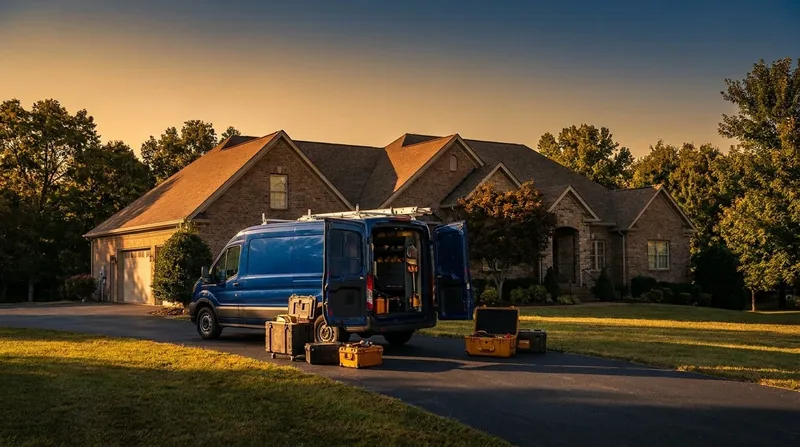
How to Start a Pest Control Business in Arizona: Office of Pest Management Licence and Scorpion Work
How to Start a Pest Control Business in Arizona: Pest Management Division License and Scorpion Work
Starting a pest control business in Arizona means getting a business license from the Arizona Department of Agriculture's Pest Management Division (PMD). PMD was formerly called the Office of Pest Management, and it is the same agency under its current name. Under ARS 3-3615, you need that license before you advertise or perform any pest management work. An Arizona pest control license is tied to a business, and a certified qualified applicator must serve as the qualifying party.
This guide covers the Arizona pest control license requirements in the order most owners tackle them: entity formation, tax registration, certification, financial security, and the PMD application. It also covers scorpion work, which falls under its own applicator category. This is informational content, not legal or tax advice.
What the Arizona Pest Control License Covers
PMD licenses the business, and the business must name a certified qualified applicator as its qualifying party. The applicator categories under ARS 3-3614 include:
- Industrial pest management
- Institutional pest management
- Structural pest management
- Health-related pest management, which covers scorpions and household pests
- Wood-destroying organisms
- Ornamental and turf
- Right-of-way
- Aquatic
- Fumigation
Choose categories based on the services you will actually sell in your first year, not every category you might offer someday. Each category has its own certification expectations, so confirm with PMD which requirements apply before you list a category on your application.
Lawn crews that apply limited herbicides may be exempt under ARS 3-3613. Do not assume your lawn service is exempt. Ask PMD to confirm your specific service in writing before you start selling it.
Materials and Documents You Will Need
Gather these items before you start filling out forms. A single missing document can stall the whole file.
- Organizing documents: Articles of Organization (Form L010, with instructions L010i) for an LLC, or Articles of Incorporation filed with a Certificate of Disclosure for a corporation.
- Statutory agent acceptance: the Statutory Agent Acceptance form (M002), signed by your agent.
- Tradename certificate: needed only if you operate under a name other than your legal entity name. Trade name registration is optional in Arizona and is handled by the Secretary of State.
- Certified qualified applicator credential: for the person who will serve as your qualifying party.
- Fingerprints: new applicants submit fingerprints as part of the application.
- Proof of financial security: at least $500,000 in liability insurance, a surety bond, or a deposit.
- Termite damage bond or rider: $100,000, required only if you treat termites.
- Application fee: $185 for the PMD business license application.
- Tax registration: a Transaction Privilege Tax (TPT) license application through the Arizona Department of Revenue.
Step-by-Step: Starting a Pest Control Business in Arizona
- Choose your entity and file with the Corporation Commission. Most small pest control owners form an LLC. The Articles of Organization filing fee is $50, filed through the Arizona Business Center at arizonabusinesscenter.azcc.gov. Regular processing takes about 9 to 11 business days, and expedited processing takes 2 to 4 business days. Expedited review adds $35, which makes an expedited Articles of Organization $85 in total. Accelerated service is a separate charge: $100 for next day (received by 5pm), $200 for same day (received by 10am), and $400 for two-hour service (available 8am to 3pm). Accelerated service guarantees examination within the stated window, not approval.
If you form a corporation instead, the Articles of Incorporation fee is $60, and the corporation must file an annual report each year for $45. An LLC files no annual report. Arizona has no LLC franchise tax or annual report fee at the Corporation Commission.
Your LLC name must include “limited liability company,” “limited company,” or one of the abbreviations LLC, L.L.C., LC, or L.C. It must not include “association,” “corporation,” “incorporated,” or an abbreviation of those words. The name must be distinguishable from existing entity names, reserved names, and registered trade names. You can reserve a name for 120 days for $10.
Your statutory agent must be a permanent, full-time Arizona resident with a permanent, full-time physical address in Arizona, or an entity authorized to transact business in Arizona. An LLC cannot serve as its own statutory agent. Changing the agent or principal address costs $5 for an LLC. You must keep a valid statutory agent on record at all times, or the company risks administrative dissolution under A.R.S. 29-3708.
An LLC must publish notice unless its statutory agent's county is Maricopa or Pima. Check with the Corporation Commission for the publication steps and timing, and confirm the publication cost with the newspaper before you budget for it.
- Register a trade name if you will use one. If you market under a name other than your legal name, register that name with the Arizona Secretary of State's Business Services Division at azsos.gov/business/tntm. This filing is separate from the Corporation Commission entity filing. Confirm the current trade name fee on that page, because this guide does not list a figure for it.
- Register for taxes and check local licenses. Apply for a TPT license through the Arizona Department of Revenue at azdor.gov. The license costs $12 per location. Ask ADOR whether your pest control services fall under a taxable classification before you assume the TPT license does not apply. Arizona has no general statewide business license, so the TPT license is a tax registration. It does not replace the PMD license.
Cities and towns commonly require their own business or TPT license on top of the state registration. Counties issue no general business license. Check the rules in every city where you will work, because the requirements are not uniform across the state.
For income tax, an LLC's income passes through to its members, who pay Arizona's flat 2.5% individual income tax. An LLC that elects corporate treatment pays the corporate income tax of 4.9% of net income or $50, whichever is greater. If any of your work counts as contracting, such as structural repair, confirm with the Registrar of Contractors whether a contractor license applies.
- Set up your qualifying party. PMD requires a certified qualified applicator to be the qualifying party. If you plan to be the applicator, complete the certification process before you file. If you hire a technician to serve as qualifying party, that person must hold the certification. Confirm the current certification steps, exam requirements, and any fees with PMD, because this guide does not list them.
- Arrange financial security before you file. Get quotes for at least $500,000 in proof of financial security. Liability insurance, a surety bond, or a deposit can satisfy the requirement. If you will treat termites, add the $100,000 termite damage bond or rider. Ask your insurance broker to confirm that the policy or bond meets PMD's form requirements, and get that confirmation in writing before you pay the first premium.
- Submit the PMD business license application. File the application with the $185 application fee. Registering the qualifying party when you file the business license costs $0. Registering the qualifying party later costs $35. Include your fingerprints, organizing documents, and tradename certificate if you use one. Make sure the business name on the PMD application matches your Corporation Commission and Secretary of State records. Ask PMD for its current processing time, because this guide does not list one.
- Start work only after the license is issued. Do not advertise or perform pest management until PMD issues the business license. Once you are licensed, calendar your renewal. Two-year renewals receive a 10% discount. Track your qualifying party's certification dates as well, since the license depends on that person staying certified.
Scorpion Work Under Your Arizona License
Scorpions and household pests fall under the health-related pest management category in ARS 3-3614. If you plan to market scorpion control, list that category on your application. Scorpion work is also where many new operators run into trouble, because customers expect fast results and a single visit often does not solve the problem.
A practical scorpion program usually follows this sequence:
- Inspect the entire property. Check the exterior foundation, wall voids, weep holes, gaps around utility lines, door sweeps, rock beds, woodpiles, and stored items in garages and sheds.
- Reduce harborage. Advise the customer to clear debris, trim vegetation that touches the structure, and reduce outdoor lighting that attracts the insects scorpions feed on.
- Apply products only as the label directs. The product label is the legal instruction for use. Apply in the locations and amounts it allows, and record what you used.
- Recommend exclusion and follow-up. Sealing entry points and scheduling follow-up visits are often necessary for lasting results. Document each visit so you can show what was done and what the customer was advised to change.
Use hedged language when you describe results. How well scorpion control works depends on the property, the season, neighboring lots, and how much harborage the customer removes. A well-run program may reduce sightings over several weeks, but no service can guarantee complete elimination. Avoid words such as “guaranteed,” “100 percent,” and “eliminates all” in your advertising.
Expected Timeline
Plan for several weeks from entity filing to a licensed start, and longer if your paperwork has errors. A regular Articles of Organization filing takes about 9 to 11 business days, and an expedited filing takes 2 to 4 business days. PMD's review time is separate, so ask for it when you file. Your insurance and bond quotes can run in parallel with the state filings, which is the fastest way to keep the timeline short.
Arizona Pest Control License Fee Summary
| Item | Amount | Agency | Notes |
|---|---|---|---|
| PMD business license application | $185 | Pest Management Division | Required before advertising or pest management |
| Qualifying party registration | $0 with business license, $35 if registered later | Pest Management Division | Filed with the business license to avoid the $35 fee |
| Financial security | At least $500,000 | Pest Management Division | Liability insurance, surety bond, or deposit |
| Termite damage bond or rider | $100,000 | Pest Management Division | Only if treating termites |
| LLC Articles of Organization | $50 | Corporation Commission | Regular processing of about 9 to 11 business days |
| Expedited review | $35 above the filing fee | Corporation Commission | Expedited Articles of Organization total $85 |
| Name reservation | $10 | Corporation Commission | Holds the name for 120 days |
| Corporation Articles of Incorporation | $60 | Corporation Commission | Filed with a Certificate of Disclosure |
| Corporation annual report | $45 | Corporation Commission | Corporations only, not LLCs |
| Statutory agent change (LLC) | $5 | Corporation Commission | Applies to changing the agent or principal address |
| Trade name registration | Confirm on the agency page | Secretary of State | Optional, filed separately from the entity |
| TPT license | $12 per location | Department of Revenue | Tax registration, not a pest control permit |
| Publication notice (LLC) | Confirm with the Corporation Commission and newspaper | Corporation Commission | Not required in Maricopa or Pima County |
| City business license | Confirm with each city | City or town | Commonly required on top of state registration |
Common Mistakes to Avoid
- Advertising before the license is issued. ARS 3-3615 bars advertising and pest management work until PMD licenses the business.
- Naming a qualifying party who is not certified. The certified qualified applicator must be the qualifying party.
- Assuming lawn work is exempt. The exemption in ARS 3-3613 is limited. Confirm your specific services before you sell them.
- Skipping the termite bond. Treating termites requires the $100,000 bond or rider in addition to the $500,000 financial security.
- Filing the qualifying party registration late. Registering later costs $35 instead of $0.
- Letting the statutory agent lapse. A missing or invalid agent can lead to administrative dissolution under A.R.S. 29-3708.
- Forgetting the LLC publication requirement. The notice is required unless the statutory agent's county is Maricopa or Pima.
- Treating the TPT license as your pest control license. The TPT license is a tax registration. Your PMD license is what authorizes pest management.
- Assuming a state filing covers city licensing. Many cities require their own license.
Tips From Practitioners
- File the PMD business license and the qualifying party registration together to avoid the $35 late fee.
- Get insurance and bond quotes early, and have the broker confirm the form PMD will accept.
- Choose your LLC name and check it against the Corporation Commission's Business Search before you pay for a reservation. The search tool is at arizonabusinesscenter.azcc.gov/businesssearch.
- Calendar the two-year renewal to keep your 10% discount, and calendar your certification renewals.
- Ask the Arizona Small Business Development Center Network (AZSBDC) at arizonasbdc.com for guidance on structuring a small service business. The SBA's Arizona district page is at sba.gov/district/arizona.
When to Consult Qualified Professionals
Talk to an Arizona business attorney before you choose your entity, draft your operating agreement, or handle publication. A CPA can help you decide between pass-through treatment and corporate treatment and can explain how the TPT license applies to your revenue. An insurance broker who writes pest control policies can confirm that your coverage meets PMD's financial security requirement. Each of these professionals costs money, but a mistake in the filing or the tax setup often costs more to fix.
Disclaimer: This article is informational content only. It is not legal, tax, or insurance advice, and it does not create an attorney-client or professional relationship. Fees, deadlines, and rules change. Before you file, confirm current requirements with the Arizona Department of Agriculture Pest Management Division, the Arizona Corporation Commission, the Arizona Department of Revenue, and your city or town.
Keep exploring: related Arizona guides
- How to Start a Lawn Care Business in Arizona
- How to Start a Pool Cleaning and Service Business in Arizona
- How to Start a Junk Removal Business in Arizona
- How to Start a Cleaning Business in Arizona
- Arizona Contractor License (ROC)
- How to Start an LLC in Arizona
- Arizona Business License
- How Much Does It Cost to Start a Business in Arizona
- All Arizona business types
- Every Arizona guide in one place