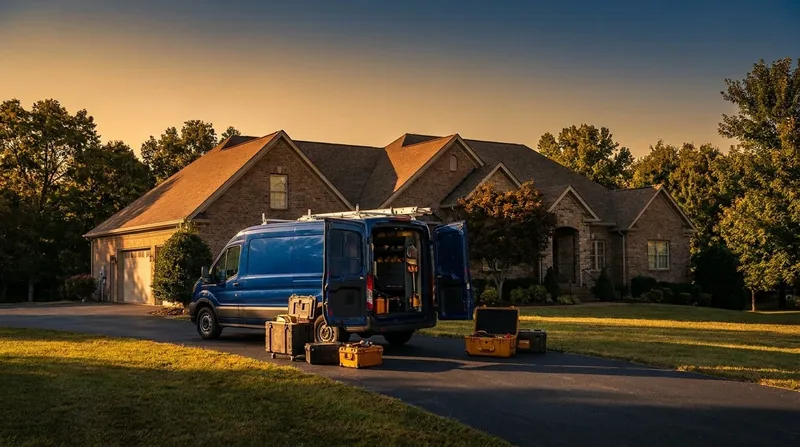
How to Start a Pool Cleaning and Service Business in Arizona: What Needs an ROC Licence
How to Start a Pool Cleaning and Service Business in Arizona: What Needs an ROC License
Pool cleaning is one of the most accessible service businesses to start in Arizona, and one of the easiest to get wrong on day one. Routine cleaning and chemical balancing are not construction work under the state contractor law (ARS 32-1101), but the moment you replace a pump, repair a heater, or make a plumbing connection, you are doing contractor work and the Registrar of Contractors (ROC) expects you to hold the right license. This guide walks through the steps in the order most owners should take them: decide your scope, form the business, handle the tax registrations, then settle the ROC question before you quote a single repair.
Informational content only. This article is general information, not legal or tax advice. Rules change, and the agency pages named below are the final word. For anything beyond routine service, talk with an Arizona attorney and a CPA before you choose a business structure or take on repair work.
Materials and equipment you will need
You can start small, but plan on putting the following together before your first paid visit:
- Cleaning equipment: telescopic poles, skimmer nets, brushes for walls and steps, a vacuum head with hose, and a vacuum or pump unit that suits the pools you will service
- Water chemistry supplies: sanitizer products, pH adjusters, alkalinity and stabilizer products, and a reliable test kit or digital tester. Keep the label and safety data sheet for every chemical on file.
- Storage and transport: a locked, ventilated chemical storage area and a vehicle with secure racks. Keep acids and oxidizers physically separated.
- Office records: a business bank account, a service agreement template, a written estimate form, and a logbook of visits and chemical readings
- Insurance: general liability coverage, and a conversation with an insurance agent about chemical handling and damage to customer property
- Formation records: your filed Articles of Organization, your statutory agent's written acceptance, and receipts for any trade name or tax registration
Step 1: Decide exactly what work you will perform
Write down your service menu before you choose a business name. The scope decides which licenses you need, and it is the step most new owners skip. Sort your planned work into three groups:
- Routine service: skimming, brushing, vacuuming, filter rinsing, and chemical balancing. ROC does not treat routine cleaning and chemical balancing as construction work under ARS 32-1101, but ROC asks you to check the position with them directly for your exact tasks before you advertise it.
- Repair and equipment work: repairs, equipment replacement, heaters, pumps, and plumbing connections. This is contractor work, and a service-only plan does not cover it.
- Gray-zone tasks: minor fixes that sit between the two, such as a small leak or a worn valve. Treat these as repair work until ROC tells you otherwise.
Your scope also determines which license classes matter. Step 6 covers the classes in detail.
Step 2: Choose a name and check that it is available
An Arizona LLC name must include "limited liability company" or "limited company," or one of the abbreviations L.L.C., L.C., LLC, or LC (A.R.S. 29-3112). The name cannot include "association," "corporation," "incorporated," or an abbreviation of those words. It must be distinguishable from existing entity names, reserved names, and registered trade names on the record.
Search the Arizona Business Center at arizonabusinesscenter.azcc.gov/businesssearch before you commit. If you need time to file, you can reserve the name for 120 days for a $10 fee through the same portal.
Avoid words like bank, credit union, deposit, or trust in your name. Those terms require prior written approval from the Arizona Department of Financial Institutions, which a pool company has no reason to seek. A name like "Desert Pool Care LLC" avoids the issue entirely.
Step 3: Form the entity with the Corporation Commission
Most small pool businesses form a limited liability company. You file Articles of Organization (Form L010, with instructions in L010i) with the Arizona Corporation Commission, Corporations Division. The regular filing fee is $50.
Expedited review costs $35 more, for a total of $85. Accelerated service is an additional charge on top of the filing fee: $100 for next-day service (received by 5pm), $200 for same-day service (received by 10am), or $400 for two-hour service (available 8am to 3pm). Accelerated service guarantees examination within the stated window, not approval.
Processing times on the Corporations Division sheet posted as of December 29, 2025 were about 9 to 11 business days for regular processing and 2 to 4 business days for expedited processing. Check the current sheet at azcc.gov/corporations before you plan a launch date.
Three requirements catch people off guard:
- Statutory agent: Arizona's term for a registered agent. An individual agent must be a permanent, full-time Arizona resident with a permanent, full-time physical address in Arizona. An entity can serve, including a foreign corporation or LLC authorized to transact business in Arizona, but an LLC cannot be its own statutory agent. The agent must accept the appointment in writing on Form M002. Changing the agent or principal address costs $5 for an LLC.
- Publication: An LLC must publish notice unless its statutory agent's county is Maricopa or Pima. If you are outside those two counties, confirm the publication procedure and timing with the Corporation Commission before you assume the filing is complete.
- Keeping the agent in place: The entity must keep a statutory agent with a valid address on record at all times. Lapse can lead to administrative dissolution under A.R.S. 29-3708.
An LLC has no annual report requirement at the Corporation Commission. Corporations do file one. The for-profit annual report is $45 and is due in the anniversary month assigned by the Commission (A.R.S. 10-1622). A corporation may request a written extension of up to six months, filed on or before the due date. A corporation also files Articles of Incorporation for $60, together with a Certificate of Disclosure. Corporations are a real option, but most owners in this trade choose the LLC because it avoids that recurring filing. Confirm the choice with your CPA.
Taxes follow the structure. An LLC is usually taxed as a pass-through, so the income reaches the members, who pay Arizona's flat 2.5 percent individual income tax. An LLC that elects corporate treatment pays the corporate income tax of 4.9 percent of net income or $50, whichever is greater (A.R.S. 43-1111).
Step 4: Register a trade name if you need one
If you will operate under a name other than your LLC's legal name, such as a shorter brand for your trucks and website, register it as a trade name. Trade names are registered with the Arizona Secretary of State, Business Services Division, not the Corporation Commission. Registration is optional in Arizona. Find the form and fee at azsos.gov/business/tntm, because this guide does not list a fee for trade name registration and you should confirm the current amount on that page.
Step 5: Sort out your tax and local registrations
Transaction Privilege Tax (TPT). Arizona has no general statewide business license. The license most businesses need is the Transaction Privilege Tax license from the Arizona Department of Revenue (ADOR), which costs $12 per location. A pool business needs to collect TPT only on taxable sales, such as chemicals or replacement parts you sell to customers. If you sell taxable goods, get the license before your first sale and collect tax on those sales. Whether your service labor is itself taxable depends on how ADOR classifies it, so confirm your status before you invoice. The state's combined rate is 5.6 percent on most taxable classifications, and county and city rates apply on top of that. Start at azdor.gov/business/transaction-privilege-tax/tpt-license.
City and county rules. Many cities and towns require their own business license or TPT license on top of the state registration. Counties in Arizona issue no general business license. Check the clerk or licensing page for every city where you will work, and call if the page is unclear. Fees differ from city to city, so this guide does not list them.
Federal tax ID. Get an Employer Identification Number from the IRS for your bank account and any future payroll.
Step 6: Settle the ROC question before you quote a repair
The Registrar of Contractors licenses contractors in Arizona. Its pool work is organized into service classes and construction classes, and the line between them matters for your pricing and your liability.
Pool service and repair classes. ROC's R-6, C-6, and CR-6 Swimming Pool Service and Repair classes (A.A.C. R4-9-102 to R4-9-104) allow servicing and minor repair. They exclude:
- potable water plumbing connections
- gas lines
- gas chlorine systems
- electrical work beyond the first disconnect
- complete plaster or pebble replacement
Construction classes. Heaters, pumps, equipment replacement, and new installations are contractor work, and ROC decides whether a service class or a construction class covers each task. The residential classes are B-5 and B-6, and B-6 includes solar heating. The commercial classes are A-9 and A-19. The dual classes are KA-5 and KA-6. Confirm which class fits your planned work before you advertise it.
The handyman exemption. A.R.S. 32-1121(A)(14) exempts small, casual, minor jobs under $1,000 from contractor licensing, and no permit is needed for that work. Treat the exemption as a narrow exception, not a business model. ROC decides how the threshold and the word "casual" apply, so confirm with ROC before you rely on it for any pool equipment job.
ROC's licensing fees, exam requirements, and bond amounts are not covered in this guide. Confirm them at roc.az.gov before you apply. Check with ROC before offering any repair, even if you believe a task is minor.
Step 7: Handle chemicals and disposal the right way
Chemical storage and disposal are governed by rules from the Arizona Department of Environmental Quality (ADEQ) and county agencies. Ask ADEQ and your county environmental or health department what applies to your storage area and to rinse water, empty containers, and spent chemicals. Never pour leftover chlorine or acid into storm drains, desert washes, or a customer's landscaping. Pools at apartment complexes and HOAs may carry additional county requirements, so confirm those before you take the account.
Step 8: Put every visit on paper
Your service agreement should state the scope, the visit frequency, who supplies chemicals, what is excluded, and that repairs are quoted separately. Give every repair a written estimate before work starts. When a job moves into ROC-regulated territory, stop, document what you found, and refer the customer to a licensed contractor. Keep the logbook of readings and visits. It is your best evidence if a customer disputes a service.
Common mistakes to avoid
- Quoting a heater or pump swap as a cleaning add-on. Once you touch the equipment, you are doing contractor work. Refer it out or get the right license first.
- Advertising repairs under a service-only plan. Your marketing, invoices, and website should describe only the work your license or exemption covers.
- Assuming an LLC files an annual report. LLCs have none at the Corporation Commission. Corporations do, at $45 for for-profit entities.
- Forgetting the statutory agent. If your agent's address lapses, the entity can face administrative dissolution.
- Skipping publication outside Maricopa and Pima. An LLC in other counties must publish notice unless the filing rules state otherwise for your situation.
- Selling chemicals without a TPT license. If you sell taxable goods, get the license first and confirm your status with ADOR.
- Treating the city as optional. Many cities require their own business license, and counties issue no general one.
- Dumping leftover chemicals. Disposal rules come from ADEQ and your county, and violations are avoidable with a short phone call.
What results to expect
A consistent weekly routine, accurate chemical testing, and a written logbook can help you keep customer pools in a balanced condition and give you clear records to point to when a customer asks what was done. Many owners find that a predictable schedule makes balancing easier to manage. Results depend on the pool, the equipment, weather, and the customer's own use, so no service can guarantee a specific water quality or a specific outcome. Describe your work in those terms in your marketing and your agreements.
Where to confirm each rule
| Question | Agency or resource | Where to start |
|---|---|---|
| Name search, reservation, Articles of Organization | Arizona Corporation Commission, Corporations Division | azcc.gov/corporations |
| Trade name registration | Arizona Secretary of State, Business Services Division | azsos.gov/business/tntm |
| TPT license and tax status | Arizona Department of Revenue | azdor.gov |
| Contractor classes, exemptions, and fees | Registrar of Contractors | roc.az.gov |
| Chemical storage and disposal | ADEQ and your county environmental or health department | Call before you store or dispose of chemicals |
| City business license | Your city or town clerk or licensing office | Check each city where you will work |
| Free small business advising | Arizona Small Business Development Center Network | arizonasbdc.com |
Next steps
Start with the scope decision in Step 1, because it determines whether you need a contractor license and which classes to pursue. Then form the LLC, handle the TPT and city registrations, and call ROC before you advertise any repair. If your plans include heaters, pumps, or plumbing, schedule a consultation with a CPA and an attorney before your first invoice goes out.
Disclaimer: This article is informational content, not legal or tax advice. Fees, processing times, and license requirements change. Confirm every figure with the agency that administers it before you rely on it.
Keep exploring: related Arizona guides
- How to Start a Pest Control Business in Arizona
- How to Start a Cleaning Business in Arizona
- How to Start a Lawn Care Business in Arizona
- How to Start a Desert Landscaping and Xeriscape Business in Arizona
- Arizona Contractor License (ROC)
- How to Start an LLC in Arizona
- Arizona Business License
- How Much Does It Cost to Start a Business in Arizona
- All Arizona business types
- Every Arizona guide in one place